V4L2Request object and API. More...
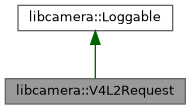
Inheritance diagram for libcamera::V4L2Request:
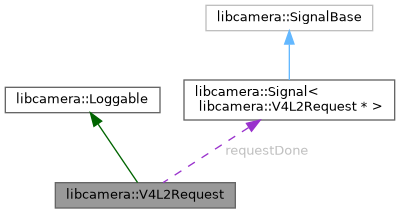
Collaboration diagram for libcamera::V4L2Request:
Public Member Functions | |
| bool | isValid () const |
| Check if the request is valid. | |
| int | fd () const |
| Get the file descriptor. | |
| int | reinit () |
| Reinit the request. | |
| int | queue () |
| Queue the request. | |
| V4L2Request (UniqueFD &&fd) | |
| Construct a V4L2Request. | |
Public Attributes | |
| Signal< V4L2Request * > | requestDone |
| Signal that is emitted when the request is done. | |
Additional Inherited Members | |
 Protected Member Functions inherited from libcamera::Loggable Protected Member Functions inherited from libcamera::Loggable | |
| LogMessage | _log (const LogCategory &category, LogSeverity severity, const char *fileName=__builtin_FILE(), unsigned int line=__builtin_LINE()) const |
| Create a temporary LogMessage object to log a message. | |
Detailed Description
V4L2Request object and API.
The V4L2Request class wraps a V4L2 request fd and provides some convenience functions to handle request.
It is usually constructed by calling MediaDevice::allocateRequests().
A request can then be passed to the V4L2Device::setControls(), V4L2Device::getControls() and V4L2VideoDevice::queueBuffer().
Constructor & Destructor Documentation
◆ V4L2Request()
| libcamera::V4L2Request::V4L2Request | ( | UniqueFD && | fd | ) |
Construct a V4L2Request.
- Parameters
-
[in] fd The request fd
Member Function Documentation
◆ fd()
|
inline |
Get the file descriptor.
- Returns
- The file descriptor wrapped by this V4L2Request
◆ isValid()
|
inline |
Check if the request is valid.
Checks if the underlying fd is valid.
- Returns
- True if the request is valid, false otherwise
◆ queue()
| int libcamera::V4L2Request::queue | ( | ) |
Queue the request.
Calls MEDIA_REQUEST_IOC_QUEUE on the request fd.
- Returns
- 0 on success or a negative error code otherwise
◆ reinit()
| int libcamera::V4L2Request::reinit | ( | ) |
Reinit the request.
Calls MEDIA_REQUEST_IOC_REINIT on the request fd.
- Returns
- 0 on success or a negative error code otherwise
The documentation for this class was generated from the following files:
- include/libcamera/internal/v4l2_request.h
- src/libcamera/v4l2_request.cpp